
Coating
Throughout the coating process, REBAR is tested regularly as an ongoing activity by skilled quality control inspectors, covering a comprehensive range of tests such as epoxy cure tests, thickness tests, continuity tests and bend testings.
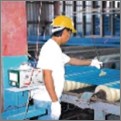
Our quality control and assurance is administered as follows:
- Quality of coating thickness in accordance with the American Society for Testing and Materials (ASTM)
- Quality of fabrication (cut & bend) in accordance with customized bar bending schedules (BBS) & bending as per ASTM mandrels radius
Reinforcing steel bars are sprayed with epoxy powder (blue) which adheres to the pre-heated surfaces and cures instantly, forming a thin film that protects the steel against all corrosion, thereby prolonging the life expectancy of the steel and concrete structure or building.

Coating Process
The coating ...
Why have bending Codes?
Within the ASTM codes for the manufacture of the high tensile deformed reinforcement steel, there are varying grades of steel (e.g. A615, A616, A617), and for each of these grades the correct bending radius must be applied.
Considerable testing has shown that when the bending radius ...
Care & Handling Bars
The following recommendations contain information about the epoxy coating characteristics, and guidelines for the proper handling of coated bars to avoid damage that might result from improper bending, cutting, and storage of bars, whether at the site or during molding.
Unloading of Bars
...
The use of epoxy-coated re-bars should be seen as part of a greater package to extend the longevity of any structure, especially those subject to harsh, corrosive environments. There is a firm belief that fusion-bonded epoxy coating adds value to structure using concrete with rebars.
The cost of maintaining, rehabilitating ...